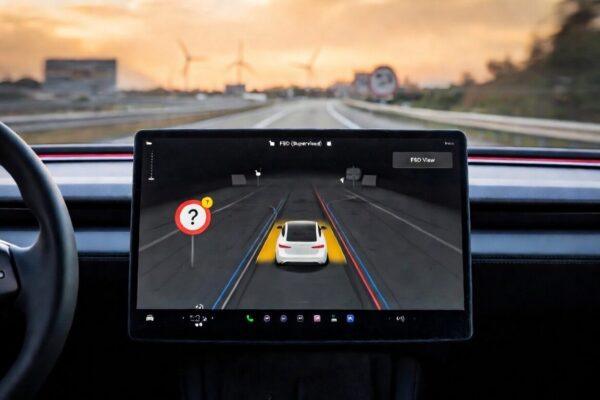
Tesla has been quietly running FSD (Supervised) demo rides across Europe for several months now, and fresh footage from the past week shows the company is already rolling out a noticeably refined user interface tailored to the region. While the core driving behavior remains rooted in the same neural nets powering North American FSD, these new on-screen elements point to early adaptation work, likely in direct response to feedback from the Dutch vehicle authority (RDW) and the stricter UNECE regulations that govern most of Europe.
Here is exactly what is new, why it matters, and what it could mean for the eventual European launch of FSD.
Clearer Speed-Limit Handling with Uncertainty Indicator
One of the most visible changes is how the car displays speed limits. When the system cannot definitively read or confirm the local limit, a prominent question mark now appears directly over the speed-limit sign icon on the visualization screen.
European demo vehicles also use a simpler Max Speed slider instead of the more granular speed-profile options seen in recent North American builds. This feels like a deliberate simplification to satisfy European regulators, who place heavy emphasis on clear, predictable oversight of drivers and compliance with speed limits. The on-screen label has also been updated to FSD (Supervised) rather than the more autonomous-sounding Self-Driving phrasing used in the US.
Enhanced Lane-Change Communication
European FSD now shows an explicit Initiating lane change notification on the display whenever the car decides to move over. At the same time, the lead vehicle being tracked is highlighted in bright yellow, a clear visual cue that the neural network is actively monitoring and reacting to that specific car ahead (or the gap it is closing).
These additions are textbook regulatory-friendly design: they give the driver an unambiguous heads-up about the car's immediate intent and reinforce that the system is still under supervision.
Dedicated FSD View Button
Perhaps the most practical new UI element is a dedicated FSD visualization button on the touchscreen. Tap it once, and the display snaps straight back to the full-screen FSD view, exactly like the existing navigation snap back button. Drivers can quickly glance at music controls, climate, or vehicle settings and instantly return to monitoring the autonomy stack without hunting through menus.
Tesla watchers expect this particular improvement to roll out globally, including in North America, because it simply makes the driver-monitoring experience less frustrating.
Why These Changes Now? Early RDW Feedback at Work?
The timing is telling. Tesla has been working closely with the RDW in the Netherlands as it prepares FSD for European type approval. UNECE rules require higher levels of driver transparency and system predictability than current US regulations, especially regarding intent signaling, speed limit handling, and fallback behavior.
These UI tweaks look like the first public evidence that Tesla is already incorporating that feedback into the European software branch. While the underlying Full Self-Driving model is largely the same, the visualization and driver-communication layer is diverging (at least for now) to meet local regulators requirements.
It is a familiar pattern: Tesla often tests region-specific refinements in one market before deciding whether to standardize them worldwide. The dedicated FSD View button is the obvious candidate for a quick global rollout, but the speed-limit question mark and yellow lead-vehicle highlighting could remain Europe-only for the foreseeable future.
What This Means for FSD in Europe
These demo-ride sightings are the strongest signal yet that a supervised version of FSD is moving closer to regulatory approval on the continent. By proactively addressing RDW and UNECE concerns in the UI itself, Tesla is showing regulators that it takes the supervised part of FSD (Supervised) seriously.
For owners and enthusiasts tracking the European rollout, the message is clear: the software is not just being translated, it is being adapted. The core autonomy capability may arrive with the same HW4/AI4 hardware already in European vehicles, but the driver-facing experience will feel subtly (and in some cases explicitly) different from the US version.
Summary of new UI changes in FSD Europe
| Feature | Description | Difference from US Version | Likely Reason / Impact |
|---|---|---|---|
| Speed Limit Uncertainty | Question mark indicator when limit cannot be confirmed | No equivalent in current US builds | Meets UNECE/RDW demand for clear driver awareness |
| Max Speed Control | Simplified Max Speed slider | More granular profiles available in US | Regulatory preference for predictable controls |
| System Labeling | FSD (Supervised) label | Often uses Self-Driving phrasing in US | Stronger emphasis on supervised status |
| Lane Change Notification | Explicit Initiating lane change message | Less explicit intent signaling in US | Improved driver transparency and intent signaling |
| Lead Vehicle Highlight | Bright yellow highlight on tracked vehicle | No equivalent in US | Makes neural net decisions more visible |
| Dedicated FSD View Button | One-tap full-screen FSD view | Not yet available in US builds | Better driver monitoring experience |
FAQ
How does Tesla improve communication during lane changes in European FSD systems?
Why has Tesla simplified the speed limit display in its European FSD demos?
What are the recent updates to Tesla FSD user interface in Europe?
What is the purpose of the new FSD visualization button in Tesla vehicles?
What is the significance of these UI changes in Tesla European FSD deployment?
This article is for informational purposes. Always refer to official Tesla communications and local regulators for the latest details.